Research Projects
Latent Language Modeling via Stochastic Process
Developing coherence metrics and latent representation models using stochastic processes.
▶ "BBScore: A Brownian Bridge Based Metric for Assessing Text Coherence." AAAI 2024 arXiv PDF
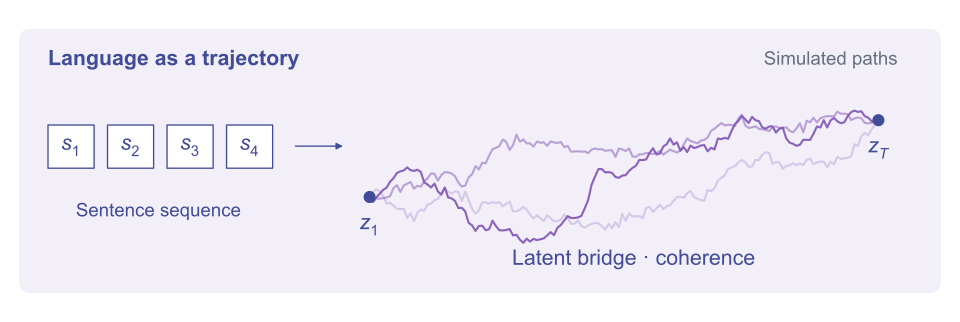
Measuring the coherence of text is a vital aspect of evaluating the quality of written content. Recent advancements in neural coherence modeling have demonstrated their efficacy in capturing entity coreference and discourse relations, thereby enhancing coherence evaluation. However, many existing methods heavily depend on static embeddings or focus narrowly on nearby context, constraining their capacity to measure the overarching coherence of long texts. In this paper, we posit that coherent texts inherently manifest a sequential and cohesive interplay among sentences, effectively conveying the central theme, purpose, or standpoint. To explore this abstract relationship, we introduce the "BBScore," a novel reference-free metric grounded in Brownian bridge theory for assessing text coherence. Our findings showcase that when synergized with a simple additional classification component, this metric attains a performance level comparable to state-of-the-art techniques on standard artificial discrimination tasks. We also establish in downstream tasks that this metric effectively differentiates between human-written documents and text generated by large language models under a specific domain. Furthermore, we illustrate the efficacy of this approach in detecting written styles attributed to diverse large language models, underscoring its potential for generalizability. In summary, we present a novel Brownian bridge coherence metric capable of measuring both local and global text coherence, while circumventing the need for end-to-end model training. This flexibility allows for its application in various downstream tasks.
▶ "BBScoreV2: Learning Time-Evolution and Latent Alignment from Stochastic Representation." EMNLP 2025 arXiv PDF
Autoregressive generative models play a key role in various language tasks, especially for modeling and evaluating long text sequences. While recent methods leverage stochastic representations to better capture sequence dynamics, encoding both temporal and structural dependencies and utilizing such information for evaluation remains challenging. In this work, we observe that fitting transformer-based model embeddings into a stochastic process yields ordered latent representations from originally unordered model outputs. Building on this insight and prior work, we theoretically introduce a novel likelihood-based evaluation metric BBScoreV2. Empirically, we demonstrate that the stochastic latent space induces a "clustered-to-temporal ordered" mapping of language model representations in high-dimensional space, offering both intuitive and quantitative support for the effectiveness of BBScoreV2. Furthermore, this structure aligns with intrinsic properties of natural language and enhances performance on tasks such as temporal consistency evaluation (e.g., Shuffle tasks) and AI-generated content detection.
Deconfounding Deep Neural Nets under Distribution Shifts
Mitigating confounding bias and distribution shifts in deep neural networks for clinical applications.
▶ "Enhancing Robustness of Foundation Model Representations under Provenance-related Distribution Shifts." DistShift Workshop @ NeurIPS 2023 arXiv
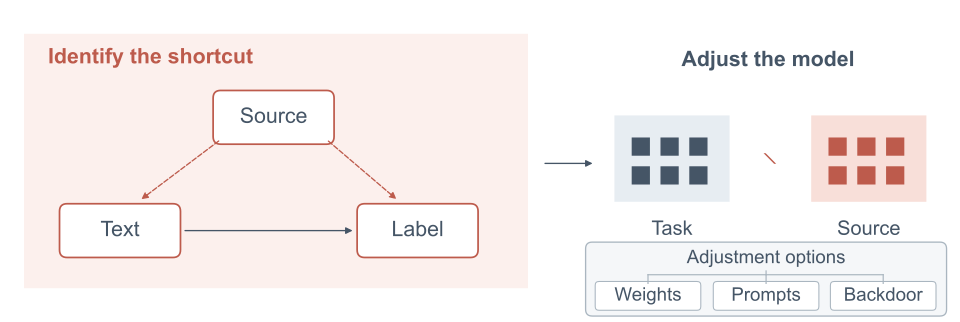
Foundation models are a current focus of attention in both industry and academia. While they have shown their capabilities in a variety of tasks, in-depth research is required to determine their robustness to distribution shift when used as a basis for supervised machine learning. This is especially important in the context of clinical data, with particular limitations related to data accessibility, lack of pretraining materials, and limited availability of high-quality annotations. In this work, we examine the stability of models based on representations from foundation models under distribution shift. We focus on confounding by provenance, a form of distribution shift that emerges in the context of multi-institutional datasets when there are differences in source-specific language use and class distributions. Using a sampling strategy that synthetically induces varying degrees of distribution shift, we evaluate the extent to which representations from foundation models result in predictions that are inherently robust to confounding by provenance. Additionally, we examine the effectiveness of a straightforward confounding adjustment method inspired by Pearl's conception of backdoor adjustment. Results indicate that while foundation models do show some out-of-the-box robustness to confounding-by-provenance related distribution shifts, this can be considerably improved through adjustment. These findings suggest a need for deliberate adjustment of predictive models using representations from foundation models in the context of source-specific distributional differences.
▶ "Backdoor Adjustment of Confounding by Provenance for Robust Text Classification of Multi-institutional Clinical Notes." AMIA 2024 PubMed PDF
Natural Language Processing (NLP) methods have been broadly applied to clinical tasks. Machine learning and deep learning approaches have been used to improve the performance of clinical NLP. However, these approaches require sufficiently large datasets for training, and trained models have been shown to transfer poorly across sites. These issues have led to the promotion of data collection and integration across different institutions for accurate and portable models. However, this can introduce a form of bias called confounding by provenance. When source-specific data distributions differ at deployment, this may harm model performance. To address this issue, we evaluate the utility of backdoor adjustment for text classification in a multi-site dataset of clinical notes annotated for mentions of substance abuse. Using an evaluation framework devised to measure robustness to distributional shifts, we assess the utility of backdoor adjustment. Our results indicate that backdoor adjustment can effectively mitigate for confounding shift.
▶ "Mitigating Confounding in Speech-Based Dementia Detection through Weight Masking." ACL 2025 arXiv PDF
Deep transformer models have been used to detect linguistic anomalies in patient transcripts for early Alzheimer's disease (AD) screening. While pre-trained neural language models (LMs) fine-tuned on AD transcripts perform well, little research has explored the effects of the gender of the speakers represented by these transcripts. This work addresses gender confounding in dementia detection and proposes two methods: the Extended Confounding Filter and the Dual Filter, which isolate and ablate weights associated with gender. We evaluate these methods on dementia datasets with first-person narratives from patients with cognitive impairment and healthy controls. Our results show transformer models tend to overfit to training data distributions. Disrupting gender-related weights results in a deconfounded dementia classifier, with the trade-off of slightly reduced dementia detection performance.
▶ "Tailoring Task Arithmetic to Address Bias in Models Trained on Multi-Institutional Datasets." Journal of Biomedical Informatics, 2025 DOI
Objective: Multi-institutional datasets are widely used for machine learning from clinical data, to increase dataset size and improve generalization. However, deep learning models in particular may learn to recognize the source of a data element, leading to biased predictions. For example, deep learning models for image recognition trained on chest radiographs with COVID-19 positive and negative examples drawn from different data sources can respond to indicators of provenance (e.g., radiological annotations outside the lung area per institution-specific practices) rather than pathology, generalizing poorly beyond their training data. Bias of this sort, called confounding by provenance, is of concern in natural language processing (NLP) because provenance indicators (e.g., institution-specific section headers, or region-specific dialects) are pervasive in language data. Prior work on addressing such bias has focused on statistical methods, without providing a solution for deep learning models for NLP. Methods: Recent work in representation learning has shown that representing the weights of a trained deep network as task vectors allows for their arithmetic composition to govern model capabilities towards desired behaviors. In this work, we evaluate the extent to which reducing a model's ability to distinguish between contributing sites with such task arithmetic can mitigate confounding by provenance. To do so, we propose two model-agnostic methods, Task Arithmetic for Provenance Effect Reduction (TAPER) and Dominance-Aligned Polarized Provenance Effect Reduction (DAPPER), extending the task vectors approach to a novel problem domain. Results: Evaluation on three datasets shows improved robustness to confounding by provenance for both RoBERTa and Llama-2 models with the task vector approach, with improved performance at the extremes of distribution shift. Conclusion: This work emphasizes the importance of adjusting for confounding by provenance, especially in extreme cases of the shift. In use of deep learning models, DAPPER and TAPER show efficiency in mitigating such bias. They provide a novel mitigation strategy for confounding by provenance, with broad applicability to address other sources of bias in composite clinical data sets.
▶ "DeconDTN-Toolkit: A Library for Evaluation and Enhancement of Robustness to Provenance Shift." CHIL 2026 arXiv
Despite the burgeoning body of work on distribution shifts, provenance shift-where the relationship between data source and label changes at deployment-remains poorly understood and under-addressed. In this paper, we establish a formal connection between provenance shift, counterfactual invariance, and invariant learning to derive a learning objective for robustness. We then introduce DeconDTN-Toolkit, a specialized evaluation and remediation suite designed to simulate provenance shifts of varying degrees while maintaining the training protocol and the infrastructure of existing benchmarks. We reveal the vulnerability of Empirical Risk Minimization under provenance shift, introduce a robust out-of-distribution performance indicator, and conduct a comprehensive evaluation on existing algorithms. Our work provides both the theoretical grounding and the practical tools necessary to characterize the problem of confounding by provenance, and implementations of methods to mitigate it.
▶ "When Prompts Interact: Assessing Prompt Arithmetic for Deconfounding under Distribution Shift." COLM 2026 arXiv PDF
In classification tasks, models may rely on confounding variables to achieve strong in-distribution performance, capturing spurious features that fail under distribution shift. This shortcut behavior leads to substantial degradation in out-of-distribution settings. Task arithmetic offers a potential solution by removing unwanted signals via subtraction of secondary model updates, but it typically requires full fine-tuning, which is computationally expensive. Prompt tuning provides a parameter-efficient alternative by adapting models through a small set of trainable virtual tokens. Task arithmetic on the resulting prompts presents an appealing alternative to operations on entire models, but the extent to which this approach can limit reliance on spurious features remains to be established. In this work, we study whether composing soft prompts through task arithmetic improves robustness to confounding shifts. We propose Hybrid Prompt Arithmetic (HyPA), which combines task prompts with linearized confounder prompts to counteract spurious correlations. Across multiple benchmarks, HyPA consistently improves the robustness-performance trade-off relative to prompt-arithmetic baselines under distribution shift. We further analyze how HyPA affects hidden representations and find evidence consistent with it mitigating confounding either by reducing the influence of confounder signals on predictions or by suppressing them in the representation. These results establish HyPA as a parameter-efficient and promising approach for improving robustness under confounding shifts in the evaluated setting.
LLM in Clinical Applications
Investigating LLM behavior, linguistic patterns, and dialogue systems for clinical and dementia-related applications.
▶ "Too Big to Fail: Larger Language Models are Disproportionately Resilient to Induction of Dementia-Related Linguistic Anomalies." ACL 2024 Findings ACL PDF
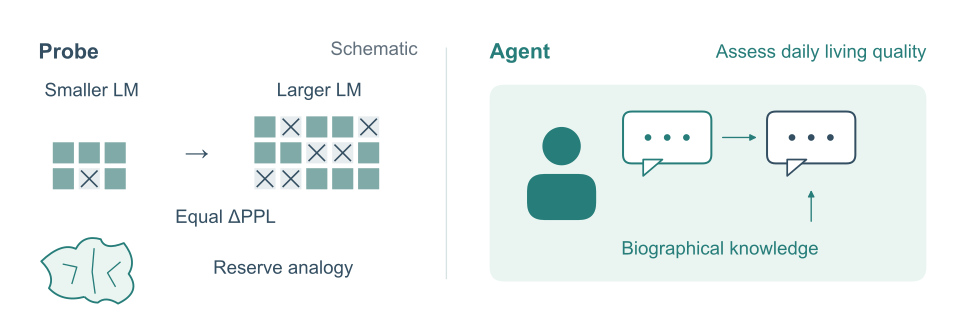
As artificial neural networks grow in complexity, understanding their inner workings becomes increasingly challenging, which is particularly important in healthcare applications. The intrinsic evaluation metrics of autoregressive neural language models (NLMs), perplexity (PPL), can reflect how "surprised" an NLM model is at novel input. PPL has been widely used to understand the behavior of NLMs. Previous findings show that changes in PPL when masking attention layers in pre-trained transformer-based NLMs reflect linguistic anomalies associated with Alzheimer's disease dementia. Building upon this, we explore a novel bidirectional attention head ablation method that exhibits properties attributed to the concepts of cognitive and brain reserve in human brain studies, which postulate that people with more neurons in the brain and more efficient processing are more resilient to neurodegeneration. Our results show that larger GPT-2 models require a disproportionately larger share of attention heads to be masked/ablated to display degradation of similar magnitude to masking in smaller models. These results suggest that the attention mechanism in transformer models may present an analogue to the notions of cognitive and brain reserve and could potentially be used to model certain aspects of the progression of neurodegenerative disorders and aging.
▶ "'Is There Anything Else?' Examining Administrator Influence on Linguistic Features from the Cookie Theft Picture Description Cognitive Test." CMCL @ NAACL 2025 arXiv PDF
Alzheimer's Disease (AD) dementia is a progressive neurodegenerative disease that negatively impacts patients' cognitive ability. Previous studies have demonstrated that changes in naturalistic language samples can be useful for early screening of AD dementia. However, the nature of language deficits often requires test administrators to use various speech elicitation techniques during spontaneous language assessments to obtain enough propositional utterances from dementia patients. This could lead to the 'observer's effect' on the downstream analysis that has not been fully investigated. Our study seeks to quantify the influence of test administrators on linguistic features in dementia assessment with two English corpora the 'Cookie Theft' picture description datasets collected at different locations and test administrators show different levels of administrator involvement. Our results show that the level of test administrator involvement significantly impacts observed linguistic features in patient speech. These results suggest that many of significant linguistic features in the downstream classification task may be partially attributable to differences in the test administration practices rather than solely to participants' cognitive status. The variations in test administrator behavior can lead to systematic biases in linguistic data, potentially confounding research outcomes and clinical assessments. Our study suggests that there is a need for a more standardized test administration protocol in the development of responsible clinical speech analytics frameworks.
▶ "A Dialogue System for Assessing Activities of Daily Living: Improving Consistency with Grounded Knowledge." DialDoc @ ACL 2023 ACL PDF
In healthcare, the ability to care for oneself is reflected in the "Activities of Daily Living (ADL)," which serve as a measure of functional ability (functioning). A lack of functioning may lead to poor living conditions requiring personal care and assistance. To accurately identify those in need of support, assistance programs continuously evaluate participants' functioning across various domains. However, the assessment process may encounter consistency issues when multiple assessors with varying levels of expertise are involved. Novice assessors, in particular, may lack the necessary preparation for real-world interactions with participants. To address this issue, we developed a dialogue system that simulates interactions between assessors and individuals of varying functioning in a natural and reproducible way. The dialogue system consists of two major modules, one for natural language understanding (NLU) and one for natural language generation (NLG), respectively. In order to generate responses consistent with the underlying knowledge base, the dialogue system requires both an understanding of the user's query and of biographical details of an individual being simulated. To fulfill this requirement, we experimented with query classification and generated responses based on those biographical details using some recently released InstructGPT-like models.
▶ "A Chatbot for Activities of Daily Living Assessment Standardization." AMIA 2023
Presents a chatbot designed to standardize the assessment of activities of daily living through conversational interaction, improving consistency and reducing clinician burden.